

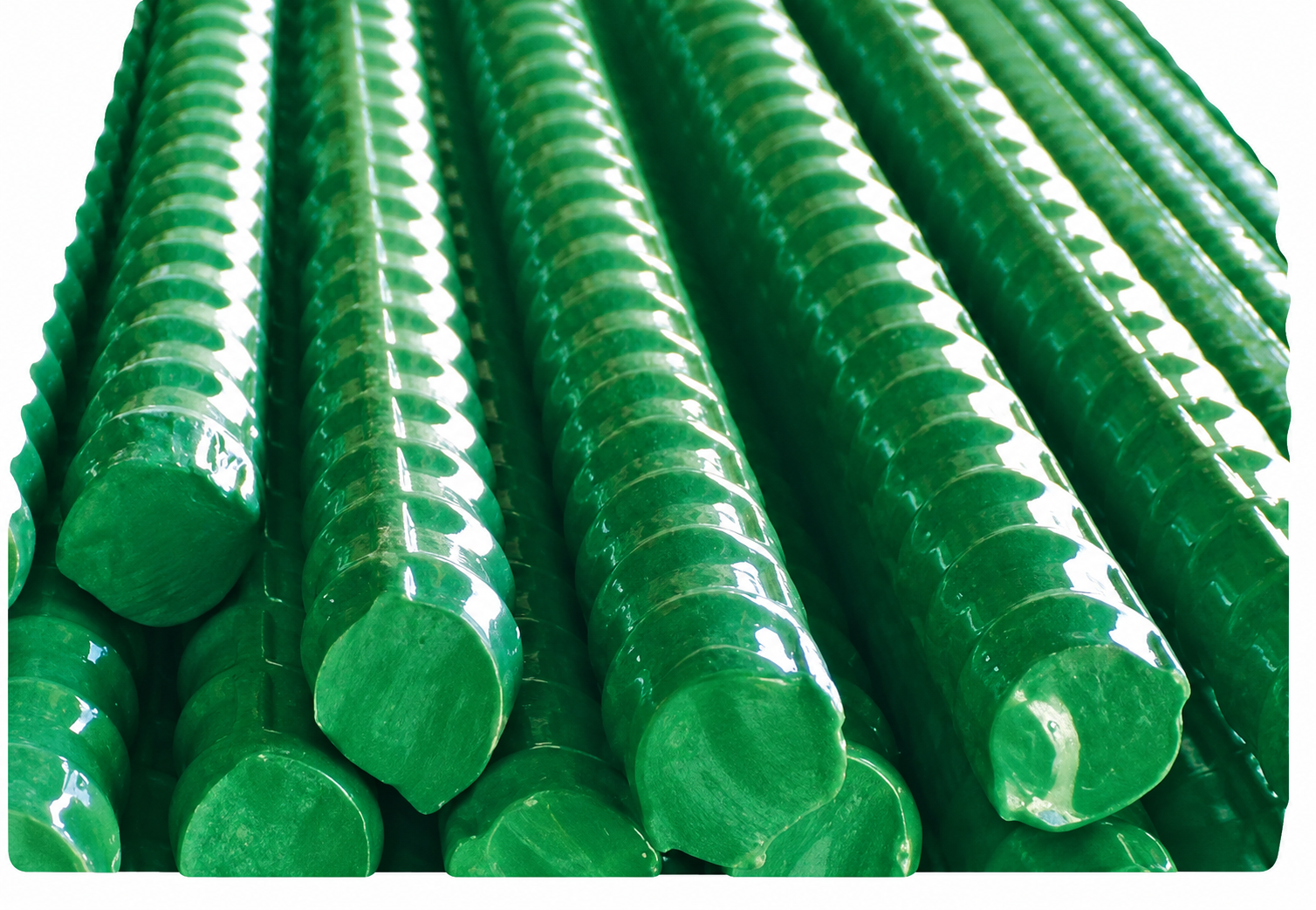
Epoxy Coated Rebar
High-durability concrete reinforcement coated with fusion-bonded epoxy to prevent corrosion from moisture, de-icing salts, and marine chlorides.
Overview
Product Overview
Epoxy Coated Rebar is an advanced concrete reinforcement material engineered to prevent steel corrosion in aggressive civil infrastructure environments. It is extensively specified in coastal zones, hot and humid marine climates, and on highway bridges subject to winter de-icing salts.
Key Advantages
- Corrosion Barrier: Provides an impervious barrier preventing moisture, oxygen, and chloride ions from contacting the steel core.
- Extended Structural Lifespan: Dramatically enhances durability and prevents premature structural degradation.
- Maintained Structural Capacity: Prevents cross-sectional loss caused by rust pitting and spalling expansion.
- Drastically Lower Maintenance: Eliminates costly concrete crack repairs, delamination patching, and cathodic protection overheads.
- Standard Workability: Can be cut, bent, and placed using conventional construction equipment on job sites.
Primary Application Fields
| Application Area | Protection Objective |
|---|---|
| Marine Ports & Sea Bridges | Protection against high-salinity seawater and chloride penetration. |
| Highway Decks & Tunnel Barriers | Resistance to seasonal chemical de-icing salts and carbonation. |
| Subway Stations & Foundation Piles | Shielding from aggressive groundwater chemistry and soil contaminants. |
| Dams & Water Treatment Plants | Long-term resistance to continuous moisture immersion and chemical exposure. |
Specifications & Structure
Product Appearance
 Epoxy Coated Rebar Surface Finish and Uniform Coating
Quality Standards & Specifications
Produced in strict compliance with quality standards based on KS D 3629, ASTM A775, and ASTM A775M.
| Parameter | Engineering Specification |
|---|---|
| Product Classification | Epoxy-Coated Steel Reinforcing Bar |
| Coating Method | Electrostatic Fusion-Bonded Epoxy Powder Coating |
| Reference Standards | Quality standards based on KS D 3629, ASTM A775 / A775M |
| Key Inspection Items | Film thickness, pinhole holiday detection, flexibility bend test, impact resistance |
Technical Information
Manufacturing Process
| Step | Process | Description |
|---|---|---|
| 1 | Surface Inspection | Pre-inspection for rebar surface defects, mill scale, and moisture. |
| 2 | Shot Blasting | High-velocity abrasive cleaning to achieve anchor profile (Sa 2.5). |
| 3 | Induction Heating | Uniform high-frequency heating to 200~250°C for optimal epoxy fusion. |
| 4 | Powder Coating | Electrostatic powder spray deposition for uniform film thickness. |
| 5 | Water Quenching | Controlled water cooling to finalize cross-linked polymer curing. |
| 6 | Holiday Testing | Inline electrical detection for microscopic pinhole defects. |
| 7 | Film Thickness & QC | Electronic dry film thickness gauge measurement and adhesion testing. |
| 8 | Protective Bundling | Bundled with padded synthetic slings to prevent handling scratches. |
| 9 | Inspection & Dispatch | Tagged with mill test certificates and shipped to domestic/global sites. |
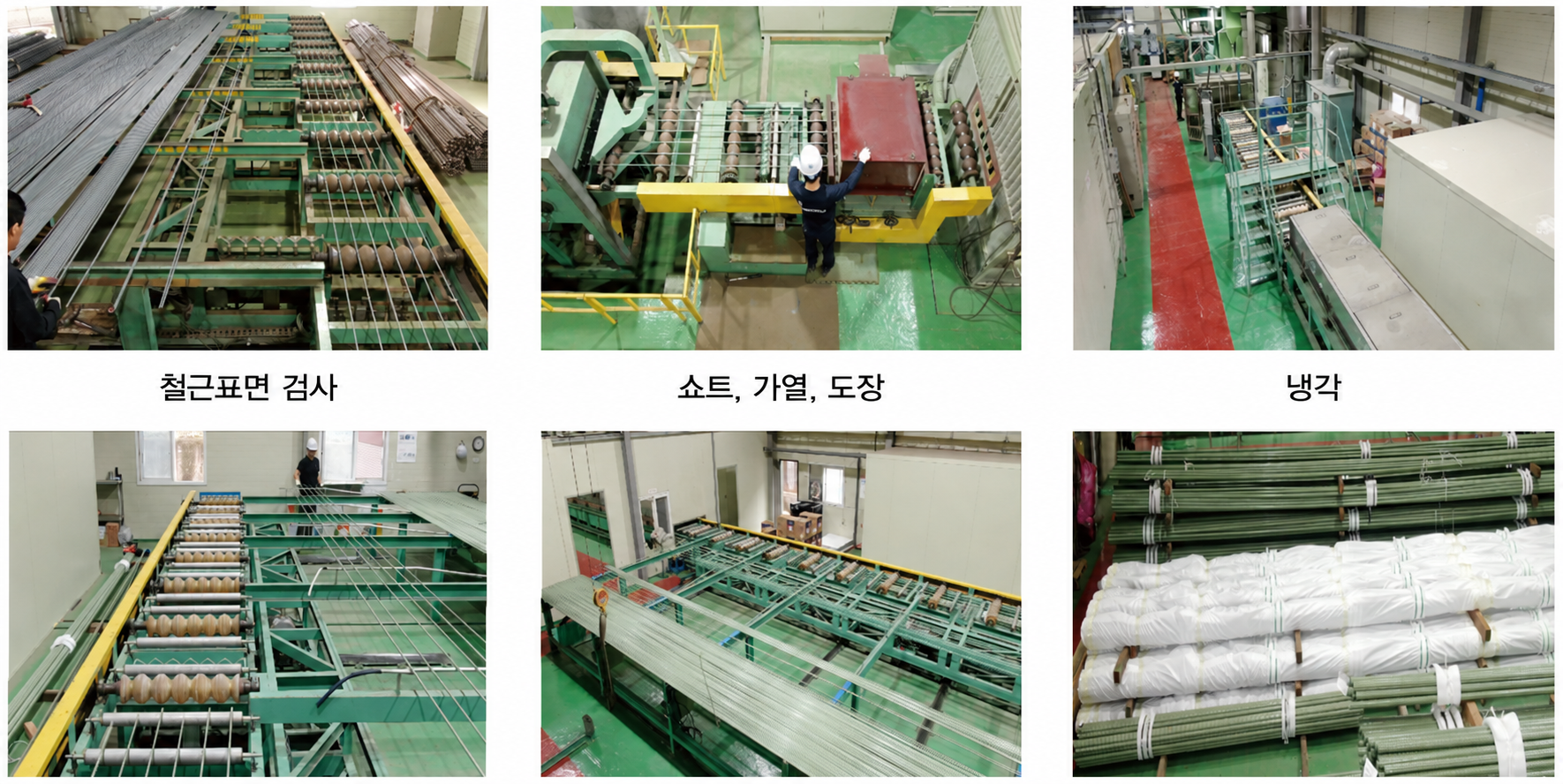 Epoxy Rebar Manufacturing: Blasting → Heating → Coating → Cooling → Holiday Test → Packaging
Job-Site Handling Guidelines
Use non-metallic padded nylon slings during lifting. Storage supports should be padded with wood or rubber to maintain the integrity of the protective epoxy film until concrete pouring.
Track Records
Explore track records for Epoxy Coated Rebar products.
Inquiry for Epoxy Coated Rebar
Please share your project conditions and required quantities. Our engineering team will review and reply promptly.